Introduction
Selling car insurance is one of the most accessible and rewarding career paths in the financial services industry. Every driver in the United States is required to carry auto insurance, which means there is always a demand for knowledgeable and trustworthy insurance agents.
Whether you are looking for a new career, a side hustle, or a way to build your own business, learning how to sell car insurance can open many doors. This guide will walk you through everything you need to know, from getting licensed to closing your first sale and building a long-term book of business.
By the end of this article, you will have a clear understanding of what it takes to succeed in the car insurance sales industry, even if you have zero experience right now.
What Is Selling Car Insurance?
Selling car insurance means helping people find and purchase auto insurance policies that protect them financially in case of accidents, theft, natural disasters, or other covered events.
As a car insurance agent or salesperson, your job is to understand a customer’s needs, explain their coverage options, and help them choose a policy that fits their budget and provides adequate protection.
There are two main types of insurance agents:
- Captive Agents: These agents work for a single insurance company. They can only sell that company’s products. Examples include agents who work for State Farm, Allstate, or Farmers Insurance.
- Independent Agents: These agents work with multiple insurance companies. They can compare quotes and policies from different providers to find the best fit for each customer.
Both paths have their own advantages, and the right choice depends on your personal goals, preferences, and business style.
Selling car insurance is not just about making a sale. It is about building relationships, earning trust, and helping people protect one of their most valuable assets, their vehicle, and their financial well-being.
The car insurance market in the United States is enormous. According to industry reports, Americans spend over $300 billion on auto insurance premiums each year. That creates a massive opportunity for anyone willing to learn the business and put in the effort.
In addition to traditional face-to-face sales, many agents now sell car insurance over the phone, through email, and even through online platforms. This means you can reach more customers than ever before, regardless of where you live.
How Does Selling Car Insurance Work?
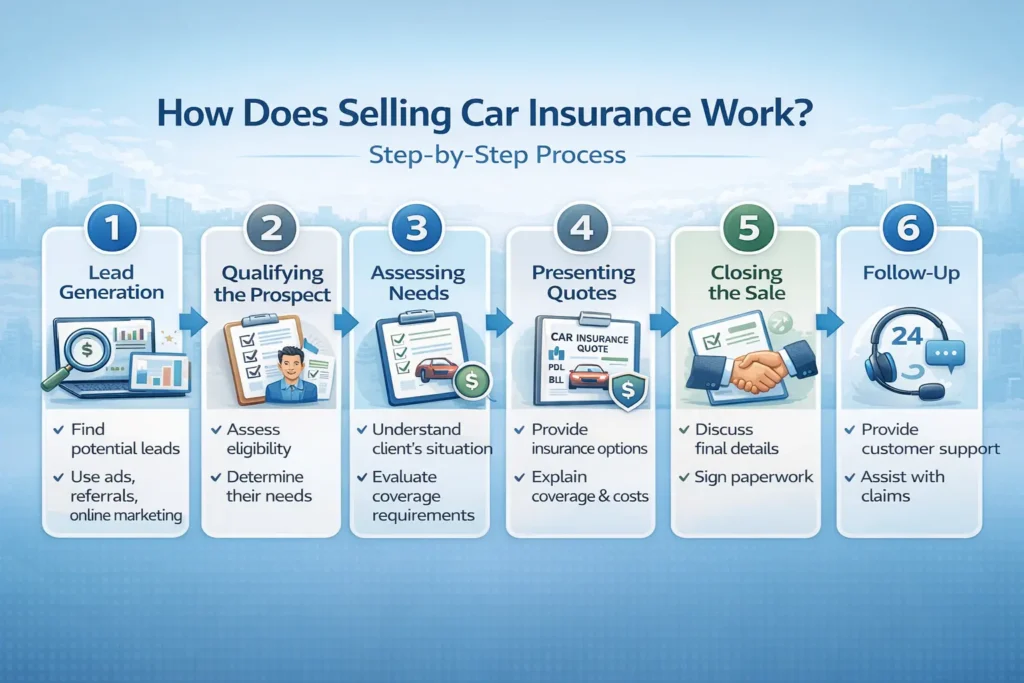
Table of Contents
Table of Contents
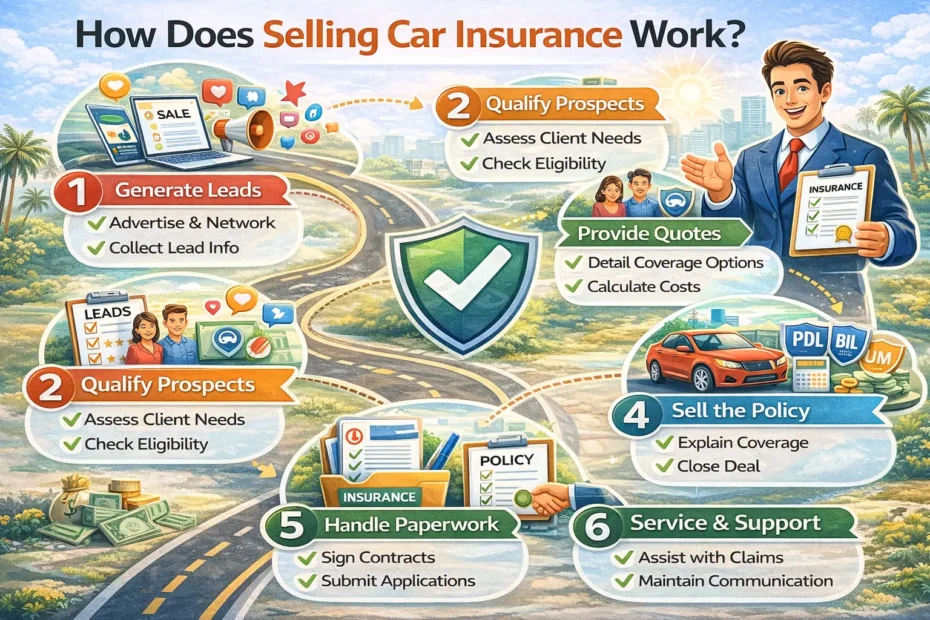
Selling car insurance follows a clear process. Here is a step-by-step breakdown of how it works from start to finish.
Step 1: Get Your Insurance License
Before you can legally sell car insurance in any state, you must obtain a Property and Casualty (P&C) insurance license. Each state has its own licensing requirements, but the general process is similar:
- Complete a pre-licensing education course. Most states require between 20 and 60 hours of coursework.
- Pass the state licensing exam. The exam tests your knowledge of insurance principles, state regulations, and policy types.
- Submit your license application and pay the required fees.
- Complete a background check if required by your state.
The entire licensing process typically takes two to six weeks, depending on how quickly you complete the coursework and schedule your exam.
Some states also require continuing education courses every one to two years to keep your license active.
Step 2: Choose Your Sales Path
Once you are licensed, you need to decide how you want to sell car insurance. Your main options include:
- Working for a captive insurance company: You join a well-known brand and sell their products exclusively. The company often provides training, leads, and marketing support.
- Becoming an independent agent: You partner with multiple insurance carriers and offer your customers a variety of options. You have more freedom but also more responsibility for generating your own leads and managing your business.
- Working for an insurance agency: You join an existing agency as a sales agent. The agency provides support, leads, and infrastructure while you focus on selling.
- Starting your own agency: You build your own insurance business from the ground up. This requires more investment and effort but offers the greatest potential for long-term income and independence.
Each path has different startup costs, income potential, and levels of support. Consider your financial situation, experience level, and long-term goals when making this decision.
Step 3: Learn the Products
To sell car insurance effectively, you need to understand the different types of coverage inside and out. The main types of auto insurance coverage include:
- Liability Coverage: Pays for damage and injuries you cause to others in an accident. This is required in almost every state.
- Collision Coverage: Pays for damage to your own vehicle from an accident.
- Comprehensive Coverage: Pays for damage to your vehicle from non-accident events like theft, vandalism, hail, or falling objects.
- Personal Injury Protection (PIP): Pays for medical expenses for you and your passengers, regardless of who caused the accident.
- Uninsured/Underinsured Motorist Coverage: Protects you if you are hit by a driver who has no insurance or not enough insurance.
- Medical Payments Coverage: Pays for medical bills for you and your passengers after an accident.
You should also understand how deductibles, premiums, coverage limits, and discounts work. The more knowledgeable you are, the more confident your customers will feel about buying from you.
Step 4: Find Your Customers
Generating leads is one of the most important parts of selling car insurance. Here are some common ways agents find new customers:
- Referrals: Ask satisfied customers to refer their friends and family. Referrals are often the highest quality leads because they come with built-in trust.
- Networking: Attend local business events, join community organizations, and build relationships with people in related industries like car dealerships, real estate agents, and mortgage brokers.
- Online Marketing: Create a professional website, use social media, and run online ads to attract potential customers searching for car insurance.
- Cold Calling: Reach out to potential customers by phone. While this method can be challenging, it is still effective when done with a helpful and respectful approach.
- Purchasing Leads: Some companies sell insurance leads to agents. These can be a good starting point, but the quality varies widely.
- Community Involvement: Sponsor local events, volunteer, and become a visible and trusted member of your community.
The best agents use a combination of these methods to build a steady stream of new business.
Step 5: Quote and Present Options
When you connect with a potential customer, you gather information about their vehicle, driving history, and coverage needs. Then you run quotes through your insurance carrier or carriers and present the options.
A good presentation should:
- Clearly explain each coverage option and what it protects against
- Show the customer different coverage levels and price points
- Highlight discounts they may qualify for, such as safe driver, multi-policy, or good student discounts
- Answer all of their questions honestly and thoroughly
- Help them understand the value of adequate coverage rather than just pushing the cheapest option
Step 6: Close the Sale
Closing the sale means the customer agrees to purchase a policy. This involves completing the application, collecting the first premium payment, and issuing the policy.
After the sale, your job is not done. Following up with customers, answering their questions, and helping them with claims or policy changes is what builds long-term relationships and generates referrals.
Step 7: Retain and Grow Your Book of Business
The most successful car insurance agents focus on retention just as much as new sales. A strong book of business provides recurring commission income and a stable foundation for growth.
Here are some ways to retain customers:
- Contact them before their policy renewal to review their coverage
- Offer additional products like homeowners or life insurance
- Provide excellent customer service at all times
- Send birthday cards, holiday greetings, or helpful insurance tips
- Be available and responsive when they have questions or concerns
Over time, your book of business grows, and so does your income. Many experienced agents earn a significant portion of their income from renewal commissions on policies they sold years ago.
Real-Life Example: Starting a Car Insurance Sales Career
Let us follow a realistic example to see how someone might start selling car insurance.
Meet Sarah. She is 28 years old and lives in Texas. She has been working in retail for five years and is looking for a career change with better earning potential and more flexibility.
Sarah decides to explore selling car insurance. Here is how her journey unfolds:
Month 1: Getting Licensed
Sarah enrolls in an online pre-licensing course for her Texas Property and Casualty license. The course costs $300 and requires 40 hours of study. She completes it in three weeks by studying a few hours each evening.
She then schedules her state licensing exam and passes on her first attempt. The exam fee is $55. After submitting her application and paying the license fee of $50, she receives her license within two weeks.
Total investment so far: approximately $405
Month 2: Choosing a Path and Training
Sarah decides to join a well-known captive insurance company as a new agent. The company provides two weeks of paid training, a small base salary for the first year, and access to leads and marketing materials.
During training, Sarah learns about the company’s products, sales techniques, customer service standards, and the technology she will use to quote and issue policies.
Months 3 to 6: Building Her Business
Sarah starts making calls, meeting with potential customers, and attending local networking events. Her first few months are challenging. She makes a lot of calls but only closes a few sales.
Here is what her early months look like:
- Month 3: 5 policies sold, earning about $500 in commission
- Month 4: 8 policies sold, earning about $800 in commission
- Month 5: 12 policies sold, earning about $1,200 in commission
- Month 6: 15 policies sold, earning about $1,500 in commission
With her base salary of $2,000 per month, Sarah’s total income in month six is $3,500. Not bad for a beginner.
Year 1 Summary
By the end of her first year, Sarah has sold 120 policies. Her average commission per policy is about $100. She earned approximately $12,000 in first-year commissions plus her $24,000 base salary, for a total of $36,000.
More importantly, she now has 120 customers who will renew their policies next year, generating recurring commission income.
Year 2 and Beyond
In her second year, Sarah continues adding new customers while earning renewal commissions on her existing book of business. Her income grows to $50,000. By year three, she is earning $65,000 or more.
Some experienced agents in her company earn over $100,000 per year after building a large book of business over five to ten years.
Sarah’s story illustrates that selling car insurance requires patience and effort in the beginning, but the long-term earning potential is significant.
Do You Know What Is How Much Insurance Do I Need in Florida?
Why Is Knowing How to Sell Car Insurance Important?
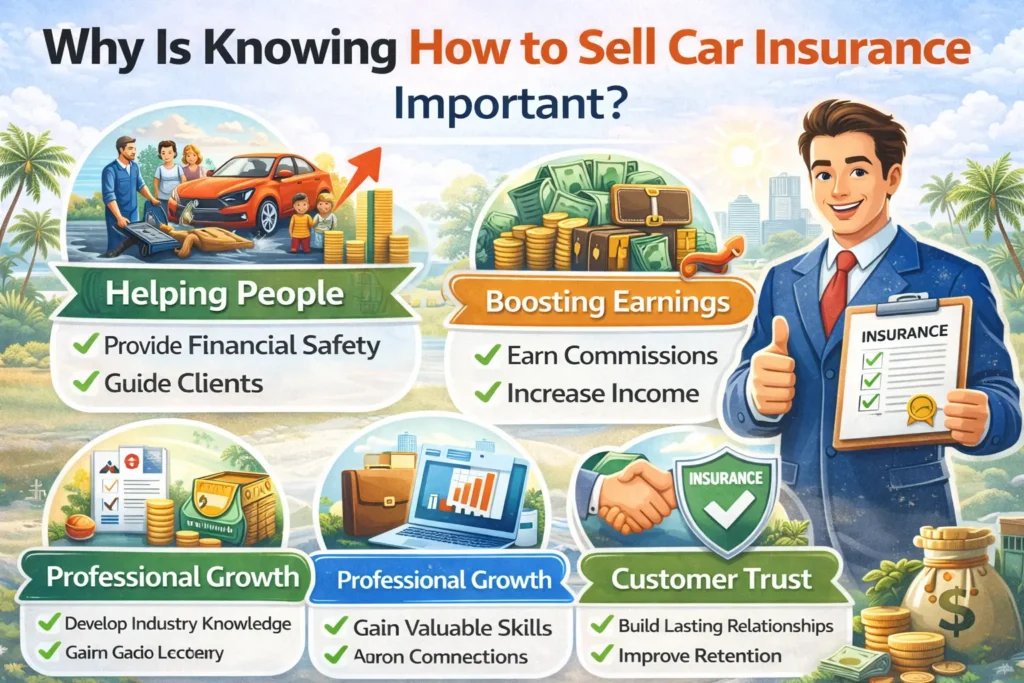
Understanding how to sell car insurance matters for several important reasons, whether you are considering it as a career or simply want to understand the industry better.
High Demand That Never Goes Away
Every state except New Hampshire requires drivers to carry some form of auto insurance. With over 230 million licensed drivers in the United States, the demand for car insurance is constant and growing.
People buy new cars, move to new states, add teenage drivers to their policies, and shop for better rates every day. This creates a never-ending stream of potential customers for insurance agents.
Accessible Career Path
Unlike many high-paying careers, selling car insurance does not require a college degree. You need a high school diploma, a state license, and the willingness to learn and work hard.
The licensing process is relatively quick and affordable compared to other professional licenses. This makes it one of the most accessible career paths in financial services.
Unlimited Earning Potential
Your income as a car insurance agent is largely determined by your effort and skill. There is no salary cap. The more policies you sell and retain, the more money you earn.
Top-performing agents can earn six-figure incomes, and those who build their own agencies can earn even more. The combination of new business commissions and renewal commissions creates a compounding income effect over time.
Flexibility and Independence
Many car insurance agents enjoy flexible schedules, especially those who work as independent agents or agency owners. You can set your own hours, work from home, and build your business around your lifestyle.
Even captive agents often have more flexibility than people in traditional nine-to-five jobs.
Helping People
Selling car insurance is not just about making money. You are helping people protect themselves and their families from financial hardship. When a customer gets into an accident and their insurance covers the costs, they are grateful for the coverage you helped them find.
This sense of purpose and service is one of the most rewarding aspects of the job.
Transferable Skills
The skills you develop selling car insurance, such as communication, negotiation, relationship building, and business management, are valuable in many other careers and industries. Even if you eventually move on to something else, these skills will serve you well.
Pros and Cons of Selling Car Insurance
Like any career, selling car insurance has both advantages and disadvantages. Here is a balanced and honest look at both sides.
Pros:
- High demand for auto insurance means a large potential customer base
- Relatively low barrier to entry compared to other financial services careers
- No college degree required to get started
- Earning potential is unlimited and grows over time with renewal commissions
- Flexible work schedule, especially for independent agents
- Opportunity to build your own business and be your own boss
- Training and support are often provided by insurance companies
- You help people protect their families and finances
- Career stability since auto insurance is legally required in most states
- Opportunities to cross-sell other insurance products like home, life, and umbrella coverage
- You develop valuable sales and relationship-building skills
Cons:
- The first year can be financially challenging with low commissions
- Rejection is a regular part of the job, especially when cold calling
- Generating leads takes consistent effort and can be frustrating at times
- Competition is high since there are many agents in most markets
- Licensing requires an investment of time and money
- Continuing education is required to maintain your license
- Customer retention requires ongoing service and follow-up
- Income can be inconsistent, especially in the beginning
- Some customers only care about price, making it hard to sell adequate coverage
- Dealing with claims and unhappy customers can be stressful
- Regulatory requirements and compliance rules must be followed carefully
The agents who succeed are those who stay consistent, focus on building relationships, and view the early challenges as an investment in their future success.
Common Mistakes People Make When Selling Car Insuranc
Whether you are brand new or have some experience, avoiding these common mistakes can save you time, money, and frustration.
Mistake 1: Focusing Only on Price
Many new agents think the best way to win customers is to offer the lowest price. While price matters, it should not be your only selling point. Customers who buy solely based on price are more likely to switch to another agent when they find a cheaper quote.
Instead, focus on educating your customers about the value of proper coverage. Help them understand what each type of coverage does and why it matters. When customers see the value in what they are buying, they are more likely to stay with you long term.
Mistake 2: Not Following Up
Many potential sales are lost simply because the agent did not follow up. A customer might need time to think, compare options, or discuss the decision with their spouse. If you do not follow up, they may buy from someone else or forget about you entirely.
Set up a system for following up with every lead. A simple phone call or email a few days after your initial conversation can make all the difference.
Mistake 3: Neglecting Existing Customers
It is easy to get caught up in chasing new sales and forget about the customers you already have. But your existing customers are your most valuable asset. They provide renewal commissions, referrals, and opportunities to sell additional products.
Make it a habit to check in with your customers regularly, not just when their policy is up for renewal. A quick call to see how they are doing or to let them know about a new discount can strengthen your relationship and reduce the chance they will leave.
Mistake 4: Not Investing in Your Education
The insurance industry is constantly changing. New products, regulations, technologies, and market trends emerge all the time. If you stop learning, you fall behind.
Take advantage of training opportunities offered by your company or carrier partners. Attend industry conferences and webinars. Read books and articles about sales, marketing, and customer service. The more you invest in yourself, the more successful you will be.
Mistake 5: Giving Up Too Soon
Selling car insurance is a long-term game. The first year is often the hardest, with low income and lots of rejection. Many people quit during this phase because they expected faster results.
The agents who succeed are the ones who push through the difficult early months and stay committed to building their business. Remember that every policy you sell adds to your book of business and your future renewal income. The effort you put in now pays off for years to come.
Mistake 6: Ignoring Online Presence
In today’s digital world, many customers search for insurance online before ever talking to an agent. If you do not have a professional website, active social media profiles, or positive online reviews, you are missing out on a huge source of potential customers.
Even a simple website with your contact information, a brief description of your services, and customer testimonials can make a big difference. Encourage satisfied customers to leave reviews on Google or other platforms.
Mistake 7: Not Asking for Referrals
Referrals are the lifeblood of a successful insurance business, yet many agents never ask for them. Most happy customers are willing to refer their friends and family if you simply ask.
Develop a referral program that rewards customers for sending new business your way. Even a small thank-you gift or discount on their premium can motivate customers to spread the word about your services.
Frequently Asked Questions (FAQs)
Do I need a college degree to sell car insurance?
No, you do not need a college degree to sell car insurance. The main requirement is a state Property and Casualty insurance license, which involves completing a pre-licensing course and passing a state exam. A high school diploma or equivalent is typically the minimum educational requirement. While a degree in business, marketing, or finance can be helpful, it is not necessary to start a successful career in insurance sales.
How much money can I make selling car insurance?
Income varies widely depending on your experience, location, sales skills, and the number of policies you sell. New agents might earn between $30,000 and $45,000 in their first year, including any base salary. Experienced agents with a large book of business often earn $60,000 to $100,000 or more per year. Top performers and agency owners can earn well over $100,000 annually. Your income grows over time as renewal commissions accumulate.
How long does it take to get an insurance license?
The timeline varies by state, but most people can complete the process in two to six weeks. This includes finishing the required pre-licensing coursework, passing the state exam, and submitting your application. Some states allow you to complete the coursework online at your own pace, which can speed up the process if you study consistently.
What is the difference between a captive agent and an independent agent?
A captive agent works for one insurance company and sells only that company’s products. They typically receive more training, support, and marketing assistance from the company. An independent agent works with multiple insurance carriers and can offer customers a wider range of options. Independent agents have more freedom and potentially higher earning potential but are responsible for more of their own business expenses and lead generation.
Is selling car insurance a good career in 2024 and beyond?
Yes, selling car insurance remains a strong career choice. Auto insurance is legally required in almost every state, which ensures ongoing demand. The industry is also evolving with new technology and digital tools that make it easier to reach and serve customers. While competition exists, there is always room for agents who provide excellent service, build strong relationships, and stay committed to their professional development.
Can I sell car insurance part-time?
Yes, many people start selling car insurance on a part-time basis while keeping their current job. This allows you to build your skills and client base gradually without the financial pressure of relying entirely on commission income. As your book of business grows, you may eventually transition to full-time insurance sales if you choose.
Conclusion
Learning how to sell car insurance is a practical and achievable goal for anyone willing to invest the time and effort. The process starts with getting your state license, choosing the right sales path, and learning the products inside and out. From there, success depends on your ability to find customers, build relationships, and provide genuine value.
The early months can be tough, and rejection is part of the journey. But the long-term rewards are well worth the effort. As your book of business grows, so does your income, your reputation, and your sense of accomplishment.
Focus on helping people rather than just making sales. When you truly care about your customers and their needs, the sales will follow naturally. Educate yourself continuously, ask for referrals, follow up consistently, and never stop improving your skills.
Car insurance is something every driver needs. By becoming a knowledgeable and trustworthy agent, you position yourself to build a stable, lucrative, and fulfilling career that can last for decades.
Whether you choose to work as a captive agent, an independent agent, or eventually start your own agency, the skills and experience you gain along the way will serve you well in every area of your life.
Take the first step today. Research the licensing requirements in your state, enroll in a pre-licensing course, and start building the foundation for your new career in car insurance sales. The opportunity is there. All you have to do is go after it.