Introduction
Car accidents can be stressful, and the financial impact often continues long after the damage is repaired. One of the biggest concerns drivers have is how long an accident will affect their car insurance. After a claim, many people notice higher premiums and wonder when things will return to normal. Understanding this process helps you plan your budget, make smarter driving choices, and avoid surprises when your policy renews.
This article explains how long a car accident affects insurance, how insurers evaluate accidents, what happens to your rates, and what you can do to reduce the long-term impact.
What is how long a car accident affects insurance?
Table of Contents
Table of Contents
“How long a car accident affects insurance” refers to the period of time an accident stays on your driving and insurance record and influences your premium price.
Insurance companies review your risk level when setting rates. If you are involved in an accident, especially one where you are at fault, insurers may consider you a higher risk driver for a certain number of years.
In simple terms:
- An accident becomes part of your insurance history
- Your insurer may increase your premium
- The impact usually lasts several years, not forever
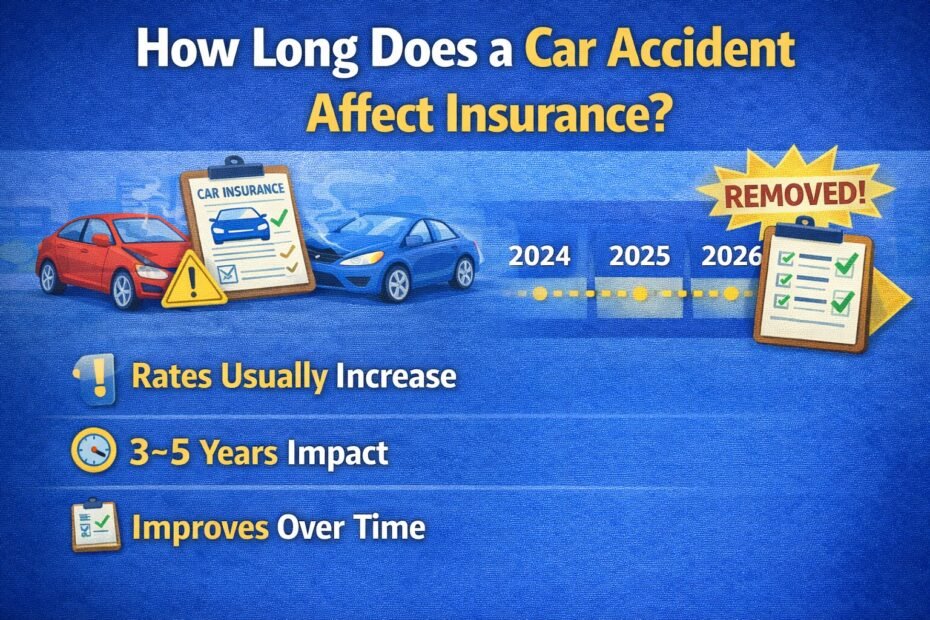
Most insurers in the United States look at driving history from the past 3 to 5 years, although this can vary by company and state rules.
Do You Know What Is How Long Do Car Accidents Stay on Your Insurance?
How does how long a car accident affects insurance work?
The process is easier to understand when broken into steps.
Step 1: The accident occurs
A crash happens, and a claim may be filed with an insurance company. Police reports, photos, and statements help determine fault.
Step 2: Fault is determined
Insurance adjusters review evidence to decide who caused the accident. At-fault accidents usually affect insurance more than not-at-fault ones.
Step 3: The claim is recorded
Once processed, the accident becomes part of your insurance record. Insurers share claim data through industry databases.
Step 4: Premium recalculation
At renewal time, your insurance company reviews your updated risk profile. If you were responsible for damages, your premium may increase.
Step 5: Impact fades over time
Each year without another accident helps improve your risk profile. Eventually, the accident stops affecting your rate.
Typical timeline:
- Year 1–2: Highest premium increase
- Year 3–4: Impact starts decreasing
- Year 5+: Often no longer considered in pricing
Real-life example
Imagine Sarah, a driver in Texas.
- She pays $1,200 per year for car insurance.
- She causes an accident resulting in $6,000 in damage.
- Her insurer covers most costs after her deductible.
At renewal, her premium increases to $1,650 per year.
Here’s what happens next:
- Year 1: Highest increase due to recent accident
- Year 2: Rate remains elevated
- Year 3: Premium begins to drop slightly
- Year 4–5: Accident carries less weight
- After Year 5: Her rates return close to normal if she drives safely
If Sarah avoids new claims and maintains a clean record, insurers gradually reward her with lower pricing again.
Why is how long a car accident affects insurance important?
Understanding this timeline helps drivers make better financial decisions.
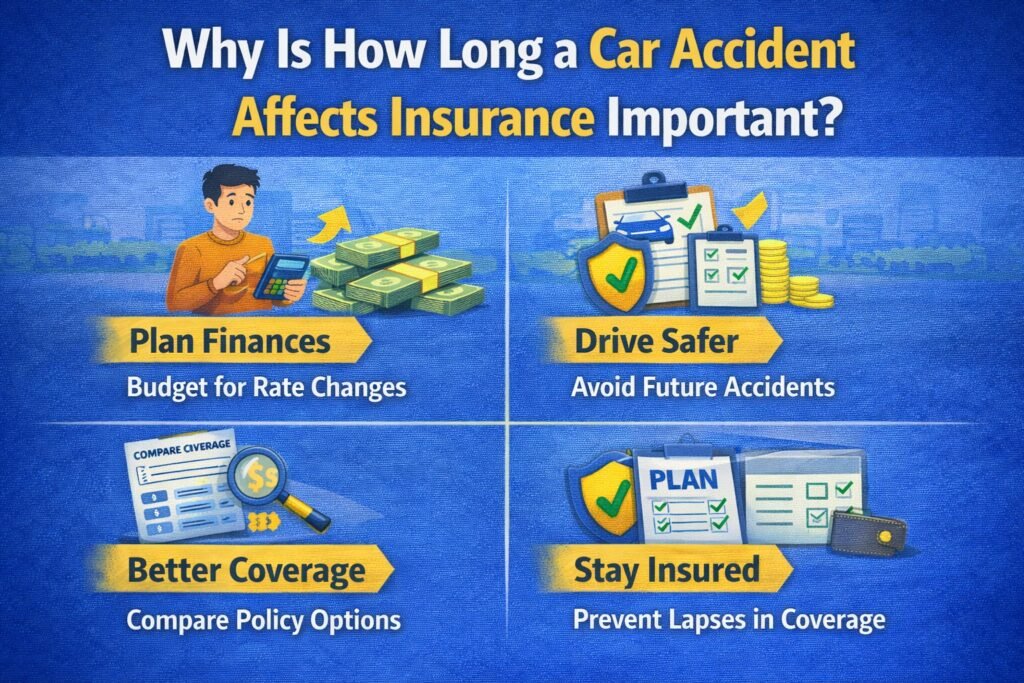
Financial planning
Insurance increases can last several years. Knowing this helps you prepare your budget.
Better driving habits
Drivers often become more cautious after learning how long mistakes can affect costs.
Smarter policy choices
You may decide to adjust coverage, compare quotes, or increase deductibles to manage expenses.
Avoiding coverage gaps
Some drivers cancel policies after a price increase, which can lead to even higher costs later.
Overall, awareness helps you stay protected while managing long-term expenses.
Pros and cons of how long a car accident affects insurance
Pros
- Encourages safer driving habits
- Rewards drivers who maintain clean records
- Helps insurers price policies fairly
- Risk decreases over time instead of lasting forever
Cons
- Premiums may rise significantly after an at-fault accident
- Financial impact can last several years
- Multiple accidents can make coverage expensive
- Some discounts may disappear temporarily
Common mistakes people make
Many drivers misunderstand how insurance works after an accident.
1. Thinking rates go up forever
Accidents usually affect insurance only for a limited period.
2. Assuming not-at-fault accidents never matter
Some insurers still consider overall claim history, even if you were not responsible.
3. Filing small claims unnecessarily
Minor repairs may cost less than long-term premium increases.
4. Switching insurers immediately without comparing
Rates vary widely. Shopping carefully often saves money.
5. Ignoring safe-driver programs
Many insurers offer discounts that help offset accident impacts.
Frequently asked questions (FAQs)
How many years does an accident stay on insurance?
Most accidents affect insurance rates for about 3 to 5 years, depending on the insurer and state.
Will my insurance drop automatically after an accident?
Usually yes. As the accident ages and you maintain safe driving, premiums often decrease gradually.
Do all accidents raise insurance rates?
Not always. Minor incidents or accidents where you are not at fault may have little or no effect.
Can I lower my premium after an accident?
You may reduce costs by improving your driving record, increasing your deductible, bundling policies, or comparing quotes.
Conclusion
A car accident does not affect your insurance forever, but it can influence your premiums for several years. Most insurers review driving history over a three-to-five-year period, with the strongest impact happening shortly after the accident. Over time, safe driving helps rebuild trust with insurers and lowers your rates again.