Introduction
Car accidents are stressful, and beyond the immediate damage, many drivers worry about how long they will affect insurance. Knowing how long an accident stays on your record is important because it can influence your insurance rates, eligibility for discounts, and future coverage options.
In this guide, we will explain what it means when a car accident appears on your insurance, how insurers use this information, how long accidents typically affect your rates, and what actions you can take to minimize their impact. This article is written in simple, clear language for beginners, so you can confidently understand your insurance record and plan ahead.
What is how long do car accidents stay on your insurance?
Table of Contents
Table of Contents
When you file a car insurance claim for an accident, insurers record it in your insurance history. This history is reviewed whenever you renew your policy or apply for a new one.
Key points to understand:
- Insurance companies track accidents that resulted in claims.
- Both at-fault and not-at-fault accidents may appear on your record.
- Accident history affects your premium rates and can influence discounts.
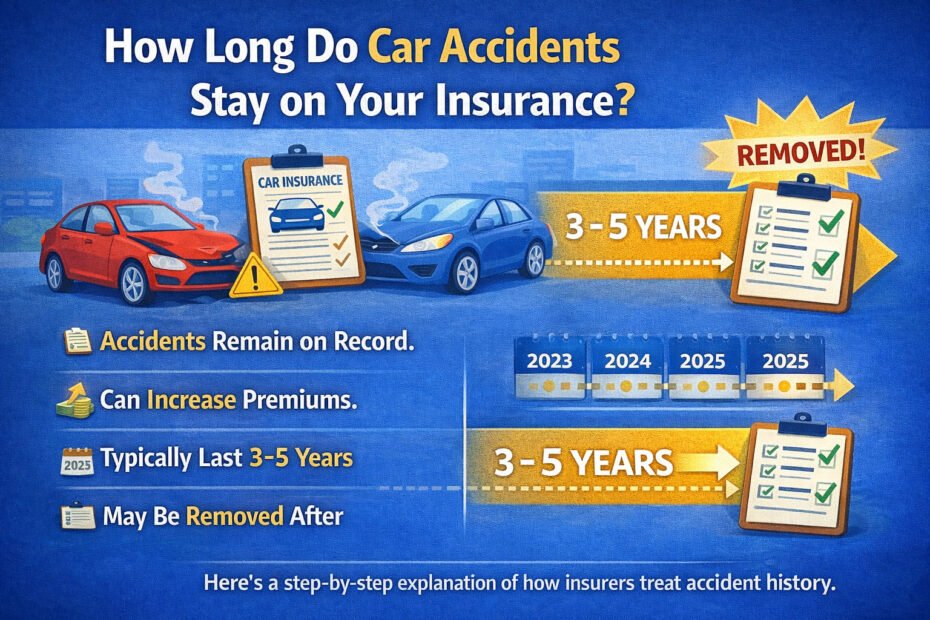
- Typically, insurance companies review the last 3–5 years of your history.
Accidents remain visible to insurers even if no tickets or citations were issued.
How does how long do car accidents stay on your insurance work?
Here’s a step-by-step explanation of how insurers treat accident history:
- Accident occurs and claim is filed
You notify your insurance company and file a claim for damages. - Insurance investigation
The insurer determines fault, estimates damages, and processes payments. - Accident recorded
The claim is logged in your insurance record, sometimes called your loss history. - Impact on premium
Your insurance company reviews your record at renewal. Accidents may raise your rates depending on fault and claim size. - Time limit for history
Most U.S. insurers consider accidents for 3–5 years. After that period, the accident generally no longer impacts rates. - Removal from record
While the accident remains in historical databases, it is usually excluded from calculations for premiums after the time limit.
Real-life example
Consider Emily, who had a minor car accident in 2021. Her insurance claim was for $2,500 in vehicle repairs.
- Her insurer increased her premium by 15% for the following year.
- After three years, her policy renewal no longer factored the accident.
- Emily’s rates gradually returned to pre-accident levels, assuming no further claims occurred.
This example shows that accidents affect premiums for a limited time and can be managed with safe driving afterward.
Do You Know What Is How Long Can You Be on Parents’ Car Insurance?
Why is how long do car accidents stay on your insurance important?
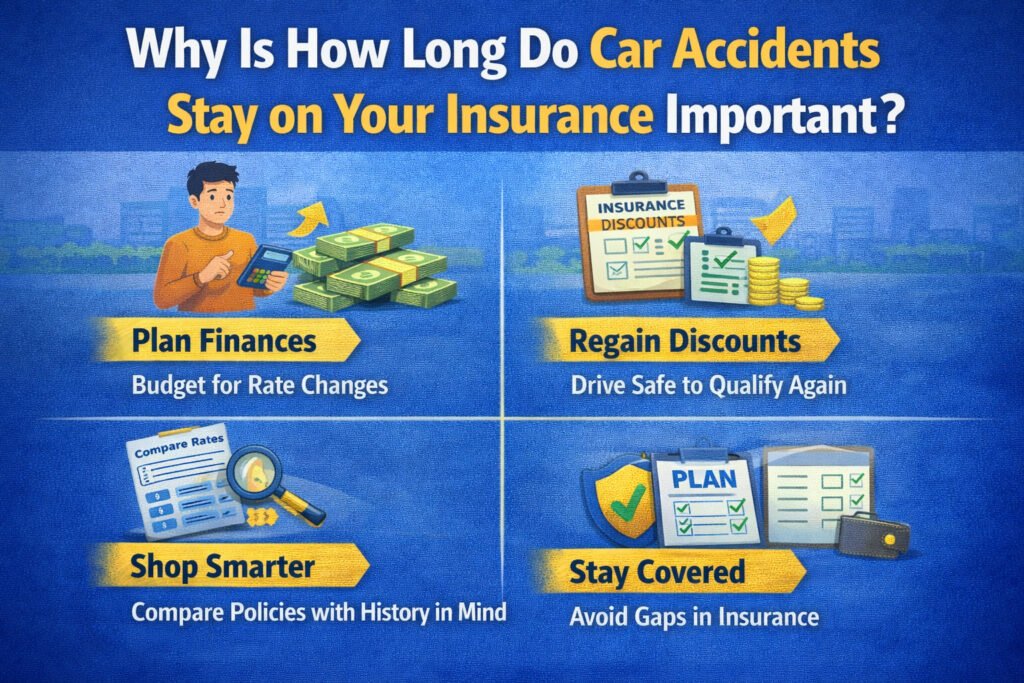
Understanding this helps drivers in several ways:
- Financial planning: You can anticipate premium changes.
- Maintaining discounts: Knowing when an accident will drop off helps plan safe driving to regain discounts.
- Insurance shopping: Helps you compare policies knowing how long your history impacts rates.
- Avoiding lapses in coverage: Understanding your history ensures continuous coverage without surprises.
Essentially, being aware of your accident history allows for smarter insurance management.
Pros and cons of accident history affecting insurance
Pros
- Encourages safe driving to avoid claims.
- Allows insurers to fairly assess risk and set premiums.
- Provides a clear record of claims history for transparency.
Cons
- Even minor accidents may temporarily raise premiums.
- At-fault accidents impact rates more than not-at-fault accidents.
- Some insurers may consider multiple past accidents when issuing new policies.
Understanding the balance helps you manage your insurance wisely.
Common mistakes people make
Many drivers misunderstand how accident history works:
- Assuming minor accidents have no effect – Even small claims can raise premiums.
- Believing not-at-fault accidents never matter – Some insurers still track them for risk assessment.
- Ignoring renewal notices – Accident history may increase rates unexpectedly if you don’t review policy terms.
- Failing to report accidents promptly – Delays can complicate claims and future record-keeping.
- Thinking accidents disappear immediately – Most remain on your record for 3–5 years.
Being aware of these mistakes helps avoid unnecessary financial surprises.
Frequently asked questions (FAQs)
How long does an at-fault accident stay on my insurance?
Typically 3–5 years, depending on your insurer and state regulations.
Do not-at-fault accidents affect my rates?
Sometimes yes, especially if your insurer tracks all accidents for risk assessment.
Can I remove an accident from my record early?
Not usually. Some insurers may offer accident forgiveness programs, but most accidents remain until the standard period passes.
Will a single accident ruin my insurance record permanently?
No. Most accidents only impact rates for a few years, and safe driving afterward can restore discounts.
Conclusion
Car accidents on your insurance record can be stressful, but understanding how long they stay and how they affect premiums can make managing your insurance much easier. Typically, accidents remain visible for 3–5 years, during which your rates may increase. After this period, the impact usually fades, allowing you to regain lower premiums if you maintain safe driving habits.