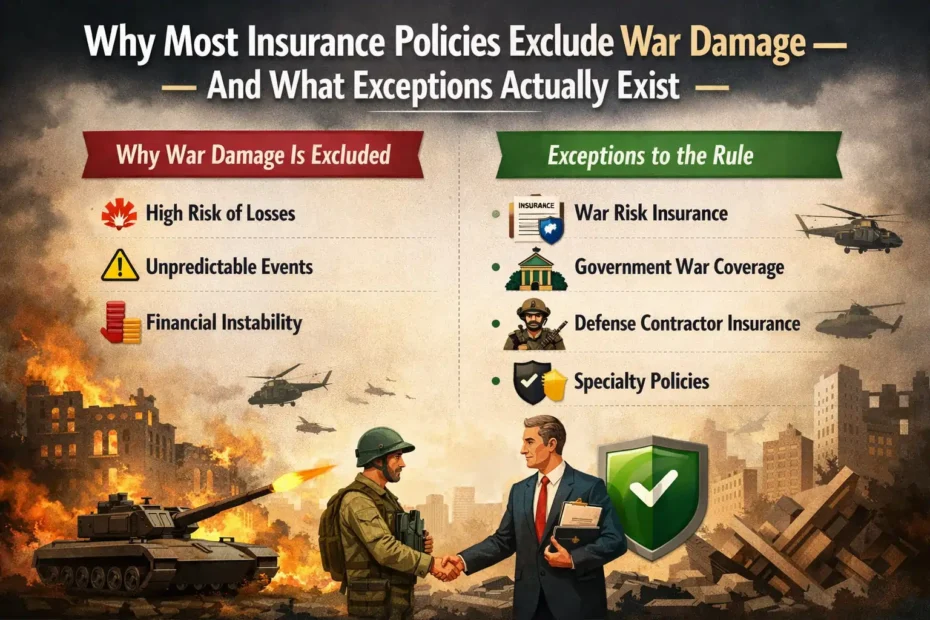
You pay your insurance premium every month. You assume you are covered. Then, in the unthinkable scenario that armed conflict reaches your property — whether overseas or, hypothetically, on US soil — you file a claim and discover something buried in the fine print: your policy has a war exclusion clause. Coverage denied.
This is not a quirk of one insurer. War exclusion clauses are found across nearly every category of US insurance — homeowners, auto, life, health, and commercial property policies. They are standard language, and they have been part of insurance contracts for well over a century. Understanding why they exist, how courts have interpreted them, and where the genuine exceptions lie can protect you from a devastating financial surprise.
This article breaks down the war exclusion clause in plain language, explains the legal and financial reasoning behind it, covers landmark programs like the federal Terrorism Risk Insurance Act (TRIA), and outlines specialized coverage options that do exist for war-related losses. Whether you own a home, run a business, or travel internationally, the information here applies directly to you.
Table of Contents
Table of Contents
What Is a War Exclusion Clause?
A war exclusion clause is a provision in an insurance policy that voids coverage for losses caused by war, invasion, acts of foreign enemies, hostilities, civil war, rebellion, revolution, insurrection, military coups, or actions taken by a sovereign military power. The exact wording varies by insurer and policy type, but the intent is consistent: if your loss traces back to armed conflict between organized forces, your insurer will not pay.
The clause usually appears in the exclusions section of a policy under language such as “War and Military Action” or “Hostile or Warlike Action.” Some policies use narrow definitions that require a formal declaration of war by the US Congress. Others use broader language that encompasses undeclared conflicts, guerrilla warfare, or even acts carried out in connection with an anticipated war.
Courts in the United States have generally interpreted war exclusions narrowly when there is ambiguity. The legal rule known as contra proferentem — which says that ambiguous policy language is construed against the insurer who drafted it — has sometimes allowed policyholders to recover when the definition of “war” was unclear. However, when the language is specific and the facts clearly involve organized military action, courts have consistently upheld the exclusion.
For American policyholders, this matters in concrete ways. US citizens with property overseas, American businesses operating in conflict zones, sailors, pilots, and overseas contractors all face coverage gaps that most domestic policyholders never think about until a loss occurs.
Why Insurance Companies Exclude War Damage
The Catastrophic Loss Problem
Insurance is built on the principle of risk pooling. Many people pay premiums, relatively few file large claims, and the insurer uses premium income to pay those claims while maintaining financial solvency. This model works when losses are statistically predictable and distributed across a large population of policyholders.
War destroys that model entirely. A single armed conflict can generate hundreds of billions of dollars in property damage, business interruption losses, and casualties across an entire region simultaneously. The 2003 invasion of Iraq caused an estimated $27 billion in infrastructure damage. The ongoing conflict in Ukraine had destroyed an estimated $150 billion in Ukrainian infrastructure by mid-2024. No private insurance pool can absorb losses at that scale. If insurers covered war damage without restriction, a single major conflict could render every insurer in the country insolvent overnight, wiping out coverage for millions of ordinary policyholders who had nothing to do with the conflict.
The Moral Hazard Problem
Moral hazard is the risk that having insurance encourages riskier behavior. If insurance covered all war-related losses without restriction, it would create perverse incentives. Businesses might take on unnecessary risk by operating in active conflict zones, knowing they would be compensated regardless of outcome. Even more problematically, it could theoretically encourage certain parties to exaggerate or misrepresent losses in connection with a conflict.
Insurance companies also cannot underwrite a risk they have no ability to quantify or control. Standard actuarial tools — mortality tables, loss frequency models, geographic risk data — are built for peacetime conditions. The moment war begins, every model breaks down. Premiums that were sufficient yesterday become wildly inadequate the next morning.
The Intentional Act Problem
Most insurance policies exclude coverage for intentional acts. War is, by definition, a deliberate action taken by organized parties. Covering intentional destruction would require insurers to essentially subsidize aggression. While this logic applies most clearly to the aggressor, insurance law does not generally distinguish between intentional acts of the policyholder and intentional acts of third parties at scale. The catastrophic, intentional, and politically directed nature of war places it in a separate risk category that private markets have never been designed to handle.
Which Types of US Insurance Include War Exclusions?
Homeowners Insurance
Standard homeowners insurance policies issued in the United States — including those built on the Insurance Services Office (ISO) HO-3 form that most major insurers use — explicitly exclude losses caused by war, including undeclared war, civil war, insurrection, rebellion, and revolution. This exclusion applies whether the damage is to the dwelling itself, personal property, or other structures on the property. Liability coverage under a homeowners policy is equally excluded for war-related claims.
Auto Insurance
Personal auto insurance policies also exclude war damage. If your vehicle is destroyed in a military strike, a civil uprising, or an invasion — whether in the US or abroad — your comprehensive auto coverage will not pay the claim. The war exclusion is typically grouped alongside nuclear hazard and government seizure in the exclusions section.
Life Insurance
Life insurance war exclusions have a complicated history. During World War I and World War II, many US life insurers added war clauses that excluded death benefits for service members killed in combat. Today, most major US life insurance companies do not exclude combat deaths, partly because of competitive pressure and partly because the federal SGLI program fills that role. However, some individual life policies still contain war exclusions, and the terms vary significantly by insurer. If you are purchasing life insurance as a service member or a contractor in a conflict zone, reading the war clause carefully is essential.
Health Insurance
Group and individual health insurance plans governed by the Affordable Care Act generally do not contain war exclusions for medical treatment received in the United States. However, health coverage for treatment received overseas in a war zone is far less certain. Most domestic health insurers do not cover care rendered outside the US at all, war or not. Travelers and overseas workers typically rely on international health insurance or travel medical insurance, both of which may contain their own war exclusions.
Commercial Property and Business Insurance
Commercial property policies, general liability policies, and business interruption coverage all carry war exclusions. This is particularly significant for US companies with operations, real estate, or supply chains in politically unstable regions. A business interruption claim stemming from an armed takeover of a facility in a foreign country will almost certainly be denied under a standard commercial property policy.
How Insurers Define “War” — and Why the Definition Matters
Not every act of violence qualifies as “war” under an insurance policy, and the distinction is legally and financially significant. Courts and insurers generally look at several factors when deciding whether an event triggers the war exclusion.
First, courts consider whether the hostile action was carried out by a sovereign or quasi-sovereign military force acting with governmental authority. A random act of violence by a criminal, even a very organized one, does not constitute war. Second, courts look at the scale and organization of the conflict. A small border skirmish between private militias is treated differently from a full-scale invasion. Third, many policies require some evidence of military tactics, weapons, or command structure.
The ambiguity between war and terrorism is where things get especially complicated for American policyholders. The September 11, 2001 attacks were carried out by a non-state actor using civilian aircraft as weapons. Were they an act of war or a criminal attack? Different insurers initially took different positions. The federal government ultimately stepped in with legislation to resolve the question, at least in part.
In 2022, a landmark legal dispute arose in the US courts when pharmaceutical giant Merck sued its insurer Ace American Insurance over $1.4 billion in losses caused by the 2017 NotPetya cyberattack, which US government investigators attributed to the Russian military. The insurer denied the claim under the war exclusion. The New Jersey Supreme Court ultimately ruled in Merck’s favor in 2023, finding the policy language was too ambiguous to clearly exclude state-sponsored cyberattacks. The ruling sent shockwaves through the US insurance industry and highlighted that the definition of “war” is not static — it is being actively litigated as new forms of conflict emerge.
The Terrorism Risk Insurance Act — A Critical Federal Exception
After the September 11 attacks caused an estimated $40 billion in insured losses — one of the largest insured events in US history — private insurers began excluding terrorism from commercial policies almost immediately. The move threatened to paralyze real estate development, construction, and commercial lending across the country, because lenders require property insurance as a condition of most commercial loans.
Congress responded by passing the Terrorism Risk Insurance Act (TRIA) in November 2002. TRIA created a federal backstop program that requires most commercial property and casualty insurers to make terrorism coverage available to their commercial policyholders. Under the program, the federal government shares losses with the private insurance industry after a “certified act of terrorism” has been declared by the Secretary of the Treasury, in consultation with the Secretary of Homeland Security and the Attorney General.
To qualify as a certified act of terrorism under TRIA, the event must be a violent act dangerous to human life, property, or infrastructure; it must be committed by an individual or individuals acting on behalf of a foreign person or foreign interest; it must be committed in an effort to coerce the civilian population or influence the policy or conduct of the US government; and aggregate insured losses from the event must exceed $200 million.
TRIA has been reauthorized multiple times. The most recent reauthorization, the Terrorism Risk Insurance Program Reauthorization Act of 2019 (TRIPRA 2019), extended the program through December 31, 2027. Under the current structure, the federal government covers 80 percent of certified losses above an insurer’s deductible — set at 20 percent of prior-year direct earned premiums — up to a program cap of $100 billion per year.
It is important to understand what TRIA does not do. It does not cover domestic terrorism — attacks carried out by US citizens or residents with no foreign direction. It does not cover acts of war between nation-states. It only applies to commercial policyholders, not individuals with personal homeowners or auto policies. And coverage is not automatic — commercial policyholders must affirmatively purchase terrorism coverage as an endorsement.
Other Exceptions and Specialized Coverage Options
War Risk Insurance for Marine and Aviation
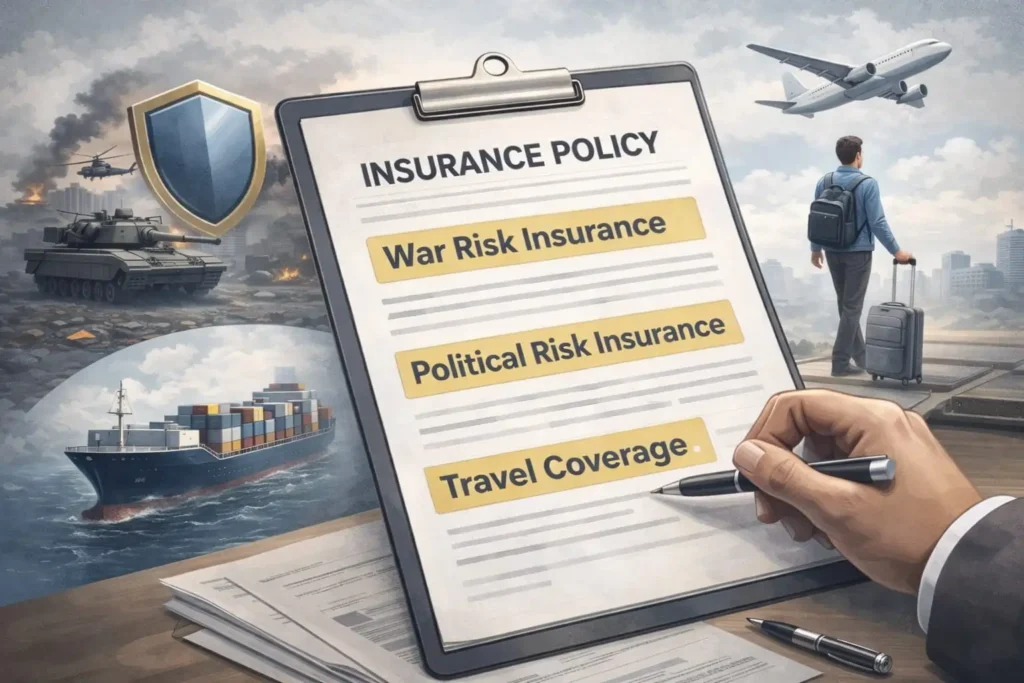
Two sectors of the US economy have long maintained specialized war risk insurance markets: maritime shipping and commercial aviation. Standard ocean marine policies exclude war risk, but policyholders can purchase a separate war risk endorsement — or a standalone war risk policy — through specialty insurers or syndicates at Lloyd’s of London, which remains the dominant marketplace for these coverages.
For US commercial aviation, the Federal Aviation Administration and the Transportation Security Administration coordinate with the aviation industry to manage war risk exposures. After September 11, 2001, the federal government provided temporary war risk coverage to US airlines under the Air Transportation Safety and System Stabilization Act, because the private market briefly withdrew entirely. The Aviation War Risk Insurance program under the FAA can be activated again if the private market fails.
Overseas Coverage Through the US DFC
American businesses and investors operating in developing countries or politically unstable regions can obtain political risk insurance through the US International Development Finance Corporation (DFC), a federal agency. The DFC offers coverage for US investments against risks including currency inconvertibility, government expropriation, and political violence — which includes war, revolution, insurrection, and civil strife.
DFC coverage is designed specifically for situations where private insurance markets either do not exist or are prohibitively expensive. For US companies expanding into Africa, Latin America, Southeast Asia, or Eastern Europe, DFC political risk insurance can be a critical tool for managing war-related exposure that no standard commercial policy would cover.
Travel Insurance and War-Related Trip Cancellations
Standard travel insurance policies contain war exclusions, but the scope varies significantly. Most travel insurers will not pay trip cancellation claims if the sole reason is a general travel advisory. However, several travel insurance products — particularly “cancel for any reason” (CFAR) add-ons — allow policyholders to cancel for virtually any reason, including personal concern about a region’s security, and receive a partial reimbursement of prepaid nonrefundable costs, typically between 50 and 75 percent.
Some travel insurers also cover emergency evacuation from a country experiencing civil unrest or armed conflict. These evacuation benefits can cover the cost of emergency transport to the nearest safe location or back to the United States. Policyholders should read the definitions of “civil disorder” and “war” carefully in any travel policy, as some insurers treat them as separate perils with different rules.
Life Insurance and the Servicemembers’ Group Life Insurance Program
The federal government runs the Servicemembers’ Group Life Insurance (SGLI) program through the Department of Veterans Affairs. SGLI provides low-cost term life insurance to active-duty service members, members of the National Guard and Reserve, and certain other categories of uniformed personnel. Coverage amounts go up to $500,000, and the program explicitly covers death in combat — there is no war exclusion. Veterans separated from service can convert their SGLI coverage to Veterans’ Group Life Insurance (VGLI) within certain time limits after separation.
When War and Terrorism Overlap: A Growing Coverage Challenge
Modern conflicts increasingly blur the line between war and terrorism. State-sponsored cyber operations, proxy conflicts using non-state militant groups, and hybrid warfare involving both conventional military forces and irregular fighters all create genuine ambiguity about which insurance exclusion applies — and whether any coverage exists at all.
The Merck/NotPetya case is one example. Another involves losses from drone strikes against civilian infrastructure — if a state actor directs a non-uniformed proxy group to carry out the strike, is it war or terrorism? US courts have not yet produced a uniform answer.
For American policyholders, the practical takeaway is this: when purchasing insurance for any scenario that might intersect with geopolitical risk — whether you are a US importer with overseas suppliers, a contractor working in a conflict-adjacent country, or a small business owner concerned about domestic unrest — read your war and terrorism exclusions with particular care. Ask your broker explicitly whether your losses would be covered if a state-sponsored cyberattack, an act of economic sabotage, or a non-state military attack caused your loss.
Practical Steps to Protect Yourself Against War-Related Coverage Gaps
Knowing the gaps is the first step. Taking action to close them is the second. Here are steps American policyholders in various situations should consider.
Review your existing policies for war, terrorism, and civil disorder exclusions. Ask your insurance agent for a plain-language explanation of each one and what events would trigger it. If you own a commercial property or business, ask your broker whether you have purchased TRIA terrorism coverage — it is not automatic, and you must affirmatively accept it as an endorsement. If you declined it in a prior policy period, it may still be available at renewal.
If your company has overseas operations or investments, ask your commercial insurance broker about political risk and war risk endorsements. For US businesses investing in developing countries, inquire specifically about DFC coverage options. If you travel internationally, especially to regions with active geopolitical tensions, purchase a travel insurance policy that includes both emergency evacuation coverage and a cancel-for-any-reason add-on.
Active military personnel and their families should verify their SGLI coverage amounts and ensure beneficiary designations are current. Civilian contractors working in conflict zones should ask their employer’s HR department about group life and disability coverage and whether war exclusions apply to those plans. For marine cargo or aviation-related businesses, work with a specialty broker who has access to Lloyd’s and other war risk markets to ensure your physical assets and cargo are properly protected when entering high-risk geographic zones.
Frequently Asked Questions
Does my standard homeowners insurance cover damage from a war on US soil? No. Standard homeowners insurance policies sold in the United States, including those based on the ISO HO-3 form, explicitly exclude losses caused by war, undeclared war, civil war, insurrection, and rebellion. If armed conflict caused damage to your home, your homeowners insurer would deny the claim under this exclusion.
Does TRIA cover individual homeowners or renters? No. TRIA only applies to commercial property and casualty insurance. It was designed to keep commercial real estate and business insurance markets functioning after a major terrorist event. Individual homeowners, renters, and personal auto policyholders are not covered by TRIA.
Are active-duty US military personnel covered by life insurance if they die in combat? Yes. The Servicemembers’ Group Life Insurance (SGLI) program administered by the Department of Veterans Affairs provides up to $500,000 in life insurance coverage with no war exclusion. Service members are automatically enrolled unless they opt out, and premiums are very low.
Can I buy war damage coverage for my home in the US? The private market does not offer war damage coverage for residential properties in the United States. This risk is considered uninsurable by private carriers because the potential scale of loss is too large to absorb. In the event of a true military attack on US soil, federal disaster relief programs administered by FEMA would likely be the primary avenue for homeowner assistance.
Does the war exclusion apply to cyberattacks carried out by foreign governments? This is an actively evolving area of US insurance law. The 2023 New Jersey Supreme Court ruling in the Merck case found that an insurer could not clearly apply a war exclusion to a state-sponsored cyberattack because the policy language was ambiguous. However, many insurers have since updated their cyber policy language to explicitly address state-sponsored attacks. Always read the war and hostile acts exclusions in your cyber insurance policy carefully.
What is the difference between a war exclusion and a terrorism exclusion? War exclusions typically apply to organized armed conflicts between sovereign or quasi-sovereign forces. Terrorism exclusions apply to violent acts by individuals or groups intended to coerce civilian populations or governments, regardless of whether a declared war exists. TRIA specifically addresses certified acts of terrorism carried out by foreign interests and provides a federal backstop for commercial insurers. The two exclusions often coexist in the same policy and can create coverage gaps when an event has characteristics of both.
Disclaimer: The information provided in this article is for general educational and informational purposes only and does not constitute legal, financial, or insurance advice. Insurance policy terms, exclusions, and applicable laws vary by state, insurer, and individual policy. Federal programs such as TRIA and SGLI are subject to change by Congress or the relevant administering agencies. Readers are strongly encouraged to review their individual insurance policies and consult with a licensed insurance professional or attorney before making any coverage decisions. The author and publisher disclaim all liability for any errors, omissions, or outcomes resulting from reliance on the information conta